Psychotherapy, Solution Focused Therapy

Clients: competent, capable, motivated

In Solution Focused Brief Therapy, we need to do everything we can to see our clients as competent, capable, and motivated.

To see them as anything else would make our jobs as therapists infinitely harder. Then we would start to distrust and lecture. We would lose faith in our clients, blinded by our belief in our own expertise.

Our clients are experts. They know more about their lives than we will ever know. Somewhere, in between the lines of everything they have experienced, said, felt, heard, noticed, touched; somewhere between the lines of every struggle and every success, is the beginning of a way forward that works for them.

Our job is to be experts of our questions, the process by which we can support our clients to reach deep within their own thinking to find their way.

Allowing our clients to own their journey recognises their individuality and allows them to own their success. We don’t prescribe what our clients must do, should do, ought to do. We simply create a space where they can describe what they are doing, in the future that contains their best hopes.

Mindfulness, Solution Focused Therapy

Seeking hope

Many of us in the UK are buckling in for a second lockdown, as the government attempts to bring soaring COVID-19 statistics back under a semblance of control.

It feels in many ways like a step backwards. A failure of sorts. A return to something we, as a community, were pretty happy to see the back of. Overwhelmed hospitals, social isolation, business shutdowns, furloughs, separation from family and friends. Uncertainty, loneliness, struggle, grief. Topped up with the grim reality that this is probably not the last COVID-19 peak. Probably not the last wave of furloughs. Probably not the last lockdown.

Against such a hopeless back drop, adopting a solution focused approach can offer some solace. In Solution Focused Brief Therapy, when we ask our clients “What are your best hopes from our talking together?” at the beginning of our first session together, we are presupposing that they have hope. No-one is without hope.

According to Snyder’s Hope theory (2002), hope is a state. We can do things to increase hope. We can do things to diminish hope. But we are never entirely without hope. 

We are never hopeless. 

Perhaps, at this challenging time, if we view ourselves, our family, our community, our society, through solution focused spectacles, we might start to notice the pockets of hope. Glowing embers of community, togetherness,  effort, empathy, creativity and growth. 

Snyder, C. R. (2002). Hope theory: Rainbows in the mindPsychological inquiry, 13(4), 249-275.

Mindfulness, Psychotherapy, Solution Focused Therapy

Ending and beginning

This month has been one of endings and beginnings for me. I achieved my qualification in Solution Focused Hypnotherapy with Clifton Hypnotherapy Practice Training, having gathered the most awesome group of friends I could have hoped for. Set against the backdrop of coronavirus and uncertainty, CPHT gifted me a year of learning and growing together – supporting each other to help others. From that nest of support, Choice Therapies was born, and it continues to grow into a nurturing community for practitioners from all walks as therapy, as they learn and grow and strive to do their best by their clients.

This month I also had a big push on my Masters thesis, exploring the use of Solution Focused Hypnotherapy for the management of chronic pain conditions. For a few weeks I was wholly submerged in data analysis and write-ups, and thanks to the incredible support of my supervisor, not to mention my family, I’m returning to the surface, as a finalised report takes shape.

And yesterday, I waved goodbye (over Zoom) to a lovely bunch of solution focused practitioners from across the globe who I had learned so much with and from over the last four months, on the Intensive Solution Focused Brief Therapy course with BRIEF International. Discussing the intricacies of this transformative approach with the solution focused greats, Adam Forever, Chris Iveson, Elliott Connie, and Evan George, was an absolute joy, and has shaped how I work with clients for the better.

So here I am, winding down, taking a moment, taking a breath. Looking back down the mountain to admire the view. These moments are important. We take stock, we process, we gain perspective on where we are right now, in this moment, and nudge the tiller if needs be to help us along the path ahead.

There’s so much to look forwards to; collaborations, projects, research, learning. Choice Therapies continues to grow into a wonderful community. My own practice continues to allow me the opportunity and privilege of watching my clients grow in strength and confidence, finding ways to manage their challenges that work for them. Many of the ventures I am fortunate to be a part of, are in their infancy. The future is full and exciting.

But for now, in this moment, I am pressing pause. Reconnecting, celebrating, and feeling grateful.

Mindfulness

How does labelling emotions help?

“If we can name it we can tame it,” says Marc Brackett, Research psychologist and Founding Director of the Yale Center for Emotional Intelligence, in his inspiring book, Permission to Feel.

By giving words to our feelings, we start to possess their power. And yet, while there are over 200 words related to emotions in the English language, we only use about 7 of these on a regular basis to describe our inside selves. This meagre diet of emotional vocabulary is woefully inadequate to express, and therefore process our thoughts, worries and fears.

Labelling our emotions is an essential part of moving them from our emotional brain to our intellectual brain. When they are confined to our emotional brain, our feelings can be intimidating. Scary. Overwhelming. Beyond our reach. We know we feel rubbish but can’t articulate why, to ourselves or to anyone else. This isolates us from support because we don’t have the words to reach out. We may not even have the words to understand we need to reach out.

We have a responsibility, to ourselves and to our children, to label feelings accurately, to develop our emotional language in order to protect ourselves from this emotional bottleneck.

Words are there, and they are ours to use; to be curious, to explore, to investigate, to express exactly how we are feeling. Only then can we release, connect and write our own stories.

Brackett, M. (2019). Permission to feel. Unlocking the power of our emotions to help ourselves and our kids, and our society thrive. Celadon Books

Solution Focused Therapy, Uncategorized

Back to school (or not): Dear parents of teens,

The road back to a normal school life stretches into the distance. 

The masks are out. The sanitiser is stocked. The yellow tape is down. The tables are spaced. A swarm of confusing new rules just got swallowed into the school day.

Our teenagers and young people have spent lockdown, locked down. And the locks on our future generations remain.

Locked out of schools they may never return to. Locked out of milestones they never got to celebrate. Locked into grades they had little control over. Locked out of gap years that have been cancelled. Locked out of careers that have been halted.

Make way for frustration. Acknowledge fears. Accept worries. Expect tears. It is a frustrating, scary, worrying time.

And yet.

Make way for creativity. Acknowledge strength. Accept individuality. Expect hope.

Mindfulness

Fighting perfectionism


I remember when I was at college, perfectionism was actively encouraged. Being perfect we rewarded. The term perfectionist was widely regarded as a compliment. 

We were told to say at job interviews that perfectionism was our one ‘weakness’, being as it was, after all, a strength…😳

Perfectionism is so destructive. It destroys our confidence, it destroys our self worth. It destroys our relationships. It destroys our joy for life. 

These days, perfectionism has lost its charm – it has been outed by many, as everything from “the enemy of creation” (John Updike) to “a slow death” (Hugh Prather).

The campaign against perfectionism is so important. For students cramming all night for those last few top marks. For workers losing evenings and weekends to make those last few changes to a project. For parents drowning in parenting advice and desperate to give their child the perfect start in life. 

Debunking the perfectionism myth is important for everyone. 

So here is my contribution. It has all been said before, and I am saying it again:

Nobody is perfect.
Nothing is perfect.
Perfection is an unattainable goal
Imperfections make the world beautiful.
Strive for excellence.
Strive for progress.
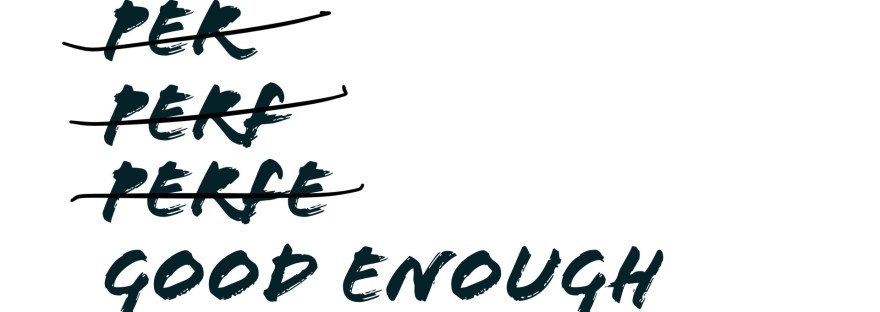
Accept good enough.

Yours faithfully,

A recovering perfectionist.